Famous reading board at the Museum van de Twintigste Eeuw
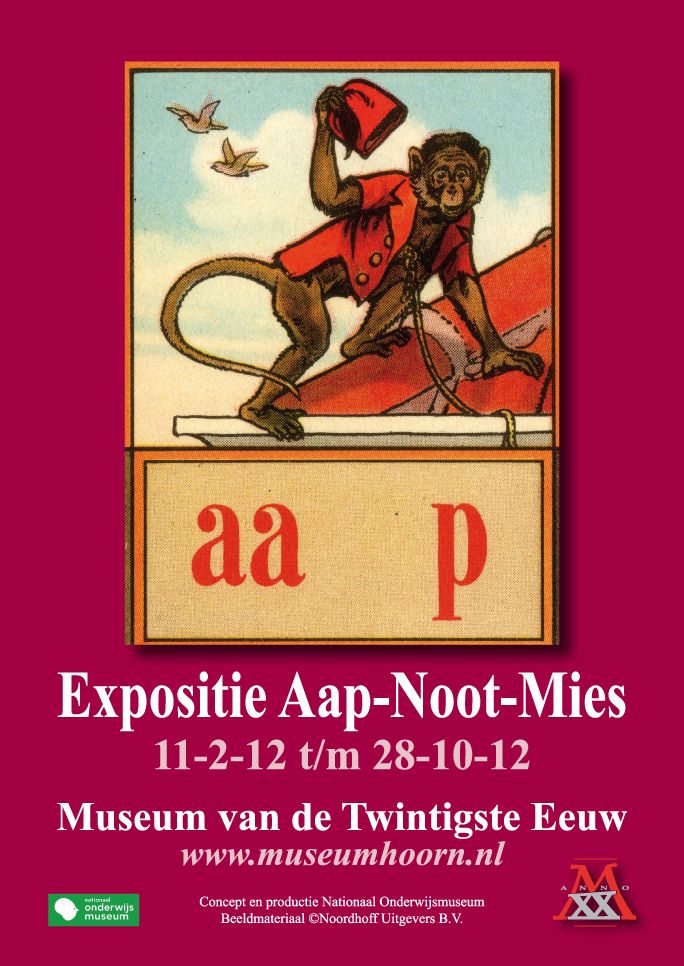
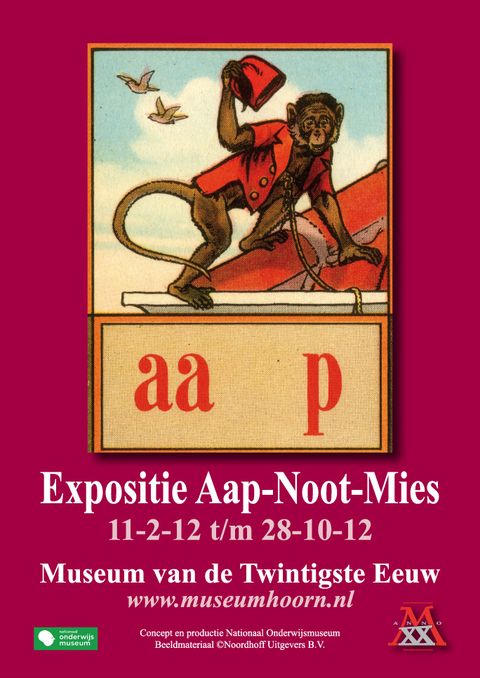
HOORN - More than 100 years ago the famous Aap-Noot-Mies reading board (the classic Dutch learn-to-read board, named after its first words: monkey, nut, Mies) came onto the market. From 1910 onwards, generations of schoolchildren learned to read with this board, the accompanying story poster, the letter box, the reading book and the classroom reading board. In the retrospective exhibition Aap-Noot-Mies, the Museum van de Twintigste Eeuw is showing this famous board, many other variants and many school wall charts from 11 February to 28 October 2012.
The reading board was designed by the teacher M.B. Hoogeveen, who used a classroom version of the board for reading lessons in his class. This version of the board was never published. Only a few years later, in 1897, did Hoogeveen design a reading board that was published by M.D. Brinkgreve in Deventer. This board began with the words Raam Roos Neef Fik Gat. Opinions about this board were by no means always positive.
Jetses story poster
Success only came from 1910, when the reading method was taken over by the publisher Wolters. They commissioned the illustrator Cornelis Jetses to make the drawings on the board. In 1931 the method was revised, and a new version of the story poster appeared to go with the improved reading board. In this new version the figures were updated to the fashion of the time.
Other boards
Not everyone will remember learning to read with the Aap Noot Mies board. For Catholic schools, for example, Brother E. Becker of Tilburg designed a reading board with the words: Aap Roos Zeef. And a special reading board was also made for pupils in the former colony of the Dutch East Indies. This board began with the words Jaap Gijs Dien.
Produced by the Nationaal Onderwijsmuseum
The Aap-Noot-Mies exhibition was put together by the Nationaal Onderwijsmuseum (National Education Museum) and can be seen at the Museum van de Twintigste Eeuw in Hoorn from 11 February to 28 October 2012. At the end of 2011 this nostalgic museum moved to a former prison complex on the Oostereiland by the harbour of Hoorn. For more information: www.museumhoorn.nl or 0229-214001.